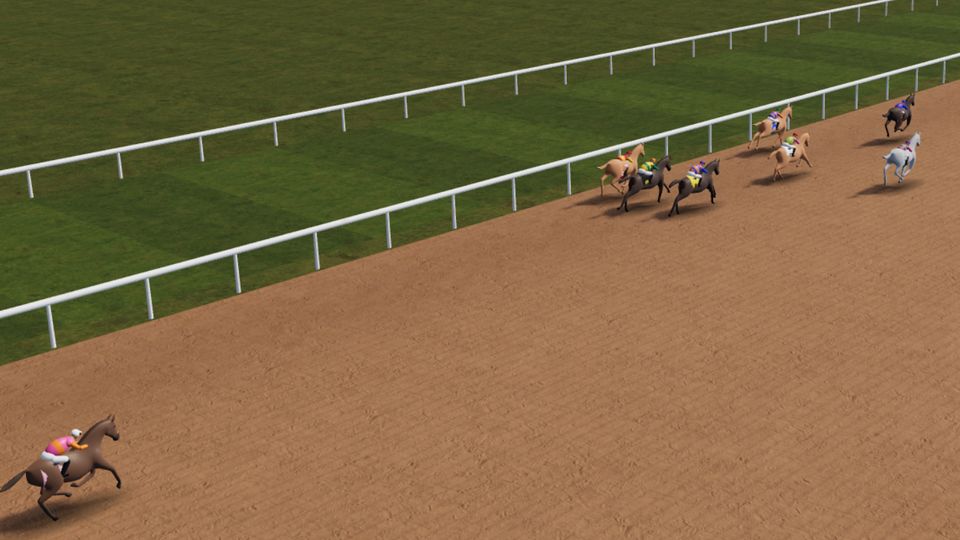
How the horse racing simulator builds a race
Each race draws eight invented runners and gives every one a true chance of winning, fixed before the gates open. The finishing order is drawn from those chances, so a horse with a 30% chance wins about three races in ten. The public pools only estimate those chances, with some noise, the way a real crowd does.
The morning line next to each name is set from the same estimate, and the live odds then drift away from it as money arrives. A favorite can drift out when the crowd backs another horse, and a long shot can shorten sharply on a few late bets, which is the same pattern seen on any tote board.
Running styles, pace and the photo finish
Every runner also gets a running style. Front-runners break fast and tire late, stalkers sit just off the pace, and closers save ground for a late run. The speed curves are scaled so each horse covers six furlongs in its assigned time, about 1:10 for the winner, and lanes shift as horses pass or fan out wide.
When the first two finish less than a tenth of a length apart, the stewards call a photo and the result waits a few seconds. Margins are reported the way a chart caller would: nose, head, neck, then lengths. Fractions are taken from the leader at two and four furlongs, and the clock stops at the wire.
Betting on the simulated race: the five pools
Win, place, show, exacta and trifecta each keep a separate pool, and an exacta box simply buys both orders of a pair. Public money is seeded into every pool when the window opens and keeps arriving until the gate, with a rush in the last seconds. Your play-money betting goes straight into the same pools and changes the prices.
The horse racing simulator uses a 16% takeout on win, place and show, the rate Keeneland publishes, and a round 19% on the exacta and the trifecta, close to Keeneland’s 19.5% exacta and a little under its 22% trifecta. The pari-mutuel betting guide has the full table, which also lists California and the harness rates at the Red Mile.
How each bet is settled
Net pool divided by the money on the winner
- Win pool $50,000
- 16% takeout leaves $42,000
- $8,000 on the 4 horse: 5.25 per dollar, 4.25 to 1, shown as 4-1
- Breakage cuts the profit to 4.20: a $2 ticket pays $10.40
Two groups of tickets share the profit
- Place pool $20,000, 16% takeout leaves $16,800
- $4,000 on the 4 and $6,000 on the 7 are returned first
- $6,800 profit, split into halves of $3,400
- The 4 pays $3.70 for $2, the 7 pays $3.00 after breakage
The same rule, split three ways
- The money on the first three finishers is returned first
- The remaining profit is split into thirds
- Each third is divided by the money on that horse
- Breakage and the $2.10 floor apply to each
First and second in exact order
- The exacta pool loses its 19% takeout
- $24,000 remains in the worked example
- $1,200 was on the right order: $20 per $1
- A $2 ticket pays $40; a box buys both orders
The first three in exact order
- Its own pool, 19% takeout
- The net pool is divided by the money on the winning combination
- Long combinations carry little money, so prices climb fast
- The tote shows the most backed combination and its probable
Breakage rounds every payout down to ten cents per dollar, and a winning $2 ticket never returns less than $2.10. The worked figures above are the same examples used in the guide, so the numbers can be checked by hand. The trifecta follows the exacta rule, with three horses that must finish first, second and third in exact order.
Free play credits and your session
The free bankroll is play money shared by this page and the race on the homepage. It starts at $100, rises and falls with every settled ticket and can be reset at any time. The table below keeps the last races played in this browser, with the winner, the margin, the $2 prices and your own result on each card.
| Race | Winner | Margin | $2 win | $2 exacta | $2 trifecta | Staked | Your P&L |
|---|---|---|---|---|---|---|---|
| No races settled yet in this browser. Results appear here after each official. | |||||||
Picture, sound and the race caller in the horse racing simulator
The 3D view of the horse racing simulator starts when you interact with the page and drops its quality when the frame rate falls. Track sound, the bugle and the crowd are generated in the browser, and the race caller reads the positions aloud at the quarter, the half and the top of the stretch.
The 3D horse is adapted from the model in 3 Dreams of Black, an interactive film by Chris Milk and Google’s Data Arts team, published under the Apache License 2.0; its coats have been recolored and the file converted for this page. The license text sits with the model file. Sky and ground textures come from Poly Haven under CC0.
From the horse racing simulator to a real track
Real tracks run the same pools as this horse racing simulator, but with real money, licensed tote systems and racing commissions watching every race. The racing schedule lists live meets at the racinos in this directory, and the racino map shows the closest track. Online wagering on races is legal only in some states, for adults, through licensed apps.