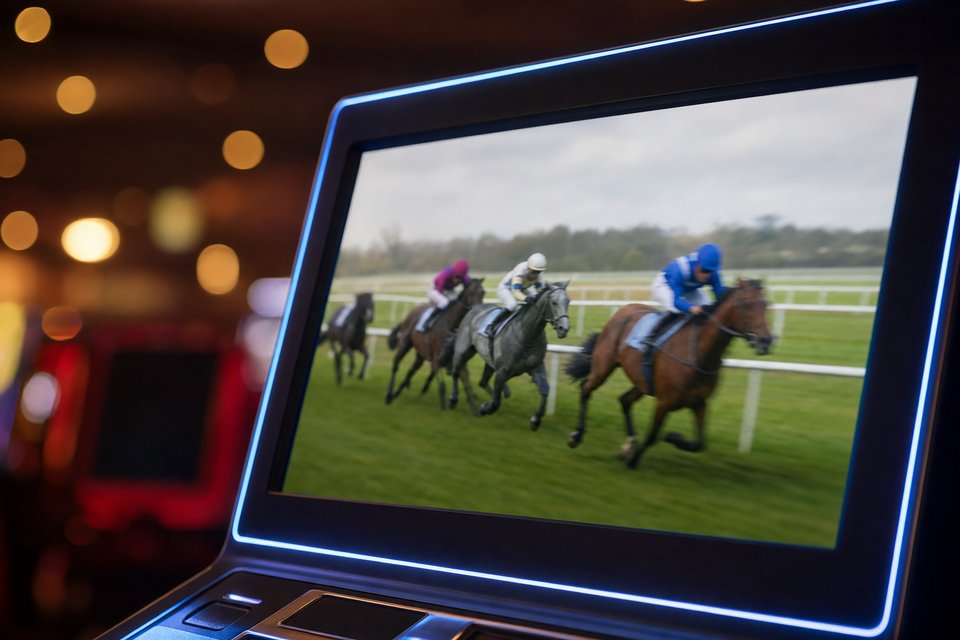
Historical Horse Racing: How It Works on the Machine
Every historical horse racing terminal draws on a library of races that were run and recorded in the past. Early systems held more than 60,000 of them. When a player presses the button, the machine selects one at random and strips out anything that would identify it, including the track, the date and the names of the horses and jockeys.
The player then sees handicapping data for the anonymized field, such as jockey and trainer win percentages, presented in charts adapted from the Daily Racing Form. Few people study them. Most press a button labelled auto-handicap, which picks a finishing order instantly, and the machine plays the result as a slot-style animation in under a second.
So in practice, how it works for the person at the screen is simple: stake, spin, result. The racing happens in the background. A replay of the race usually runs in a small window in the corner, and some machines show a computer-generated re-enactment instead of real footage, but the reels carry the display.
The Pari-Mutuel Pools Behind the Reels
The legal heart of historical horse racing is the pool. Each wager is split among pools tied to different outcomes, such as picking the winner or the first three in exact order. When a player’s selection hits, the payout comes from that pool, while money in the pools that did not hit keeps growing until another player wins it.
The state takes a fixed percentage from the pools as takeout, as it does on live race betting, and the operator keeps a share. The house does not bet against the player, which is the argument that makes these machines legal in states where slot machines are not. The pari-mutuel betting guide explains the same mechanics for live races.
Critics point out that the pools are thin and that winners rarely share them with anyone, so the experience is closer to a slot than to a racetrack. Kentucky’s Supreme Court accepted part of that argument in 2020, ruling that one product did not meet the definition of pari-mutuel wagering then written in state law.
The Legal History of Historical Horse Racing
The idea came from Oaklawn Park in Hot Springs, Arkansas, where Eric Jackson proposed it in January 1997. Arkansas lawmakers approved Instant Racing in 1999, and in January 2000 Oaklawn and Southland Greyhound Park each opened 50 terminals. Both venues later added full casinos under Amendment 100, which voters approved in November 2018.
Kentucky followed a decade later. The Horse Racing Commission changed its definition of pari-mutuel wagering in July 2010, a court upheld the regulation that December, and Kentucky Downs opened its machines on September 1, 2011. Ellis Park added terminals in 2012, and the Red Mile in Lexington followed in September 2015.
The format then faced its biggest test. In February 2014 the Kentucky Supreme Court said the commission could license historical horse racing and sent the case back. In September 2020 it ruled that the machines in question were not pari-mutuel, and a rehearing was denied in January 2021. The Red Mile closed its gaming briefly while lawmakers responded.
The response was SB 120, which passed in February 2021 and rewrote the definition of pari-mutuel wagering in statute. That law secured the industry, and expansion resumed quickly, with new or rebuilt gaming halls at Turfway Park, Oak Grove and Cumberland Run. By 2025 Kentucky had 13 historical horse racing properties.
Virginia took a direct route. A law signed in April 2018 allowed machines at Colonial Downs and up to ten satellite locations, with the aim of reopening the New Kent track after several dark years. Rosie’s Gaming Emporium opened there on April 23, 2019, and Churchill Downs Inc. bought the business in 2022. The Virginia page lists every location.
Where HHR Machines Operate in 2026
Kentucky and Virginia hold the largest networks, followed by Wyoming, where parlours spread across small towns. Smaller operations run in New Hampshire, Alabama, Arkansas and Kansas, each under its own statute or court ruling. The list covers states where historical horse racing machines are licensed in 2026 and the venues most visitors know.
- Kentucky: tracks and satellites including Derby City Gaming, Turfway Park, Oak Grove, the Red Mile and Ellis Park.
- Virginia: Rosie’s Gaming Emporium halls, The Rose in Dumfries and Colonial Downs.
- Wyoming: off-track parlours tied to licensed race meets.
- New Hampshire: charitable gaming halls, authorized in 2021.
- Alabama: Birmingham Race Course, GreeneTrack and VictoryLand.
- Kansas: a single Sedgwick County license of up to 1,000 machines.
- Arkansas: the original Instant Racing states, now inside full casinos.
The largest single halls hold more than a thousand machines. Derby City Gaming in Louisville listed 1,247 terminals in September 2026, and The Rose Gaming Resort in Dumfries, Virginia, about 1,650. Rosie’s in Richmond counts around 1,200. None of these buildings stands at a racetrack, yet each operates under a track’s license and shares revenue with racing.
Wyoming’s network is spread thin. Machines arrived in 2003, were removed in 2005 and were ruled illegal in 2006, when a court called them a slot machine that attempts to mimic pari-mutuel wagering. The legislature re-legalized them in 2013, and by 2023 there were 2,486 machines at 43 parlours with an annual handle of about $1.7 billion.
Revenue: What the Machines Pay Racing
The sums are large. At a Kentucky Horse Racing Commission meeting in April 2023, historical horse racing handle was reported at $693 million for February alone, against $574 million a year earlier. Fiscal-year wagering through February stood at $5.2 billion, about $1 billion more than at the same point of the previous year.
Part of that money flows into purses at every Kentucky track, including meets with little betting of their own. The commission has moved purse money from tracks with strong machine revenue to Ellis Park, and the purse growth at Kentucky Downs, whose short turf meet runs in late summer, is paid for by the gaming halls tied to its license.
Kansas shows how the split can be written into law. Its 2022 statute allows one Sedgwick County license with up to 1,000 machines and sends 3 percent of gross revenue to racing, split 30 percent to horse breeding and 70 percent to fair racing. Live thoroughbred racing is scheduled to return at Eureka Downs in October 2026.
Controversies and Court Fights Over HHR Machines
Few gaming formats have been litigated as often. Texas adopted rules in August 2014, a court struck them down that November, and the rules were later repealed. Idaho legalized machines in 2013 and banned them in 2015 after the Coeur d’Alene Tribe sued, and voters rejected a measure to bring them back in 2018.
Louisiana authorized up to 50 historical horse racing machines per off-track betting parlour in 2021. A Baton Rouge judge ruled the law unconstitutional in March 2024, and the state Supreme Court upheld that decision in March 2025. In Minnesota, the racing commission approved 500 machines each at Canterbury Park and Running Aces in 2024, and the legislature then banned them.
California is the newest dispute. Santa Anita installed 26 PariMax machines in January 2026; the state Justice Department seized them, and the track sued. Tribes that hold exclusive rights to slot-style gaming in California have led the opposition there, as they did in Idaho and Minnesota, arguing that the machines are slots in everything but name.
Supporters answer with results. Historical horse racing revived Colonial Downs, funded new facilities across Kentucky and brought live racing back to Wyoming. Other countries have studied how it works, and the format reached Europe in 2024, when Churchill Downs, Exacta, IGT and Malta’s national lottery opened machines in Malta, the first installation outside the United States.