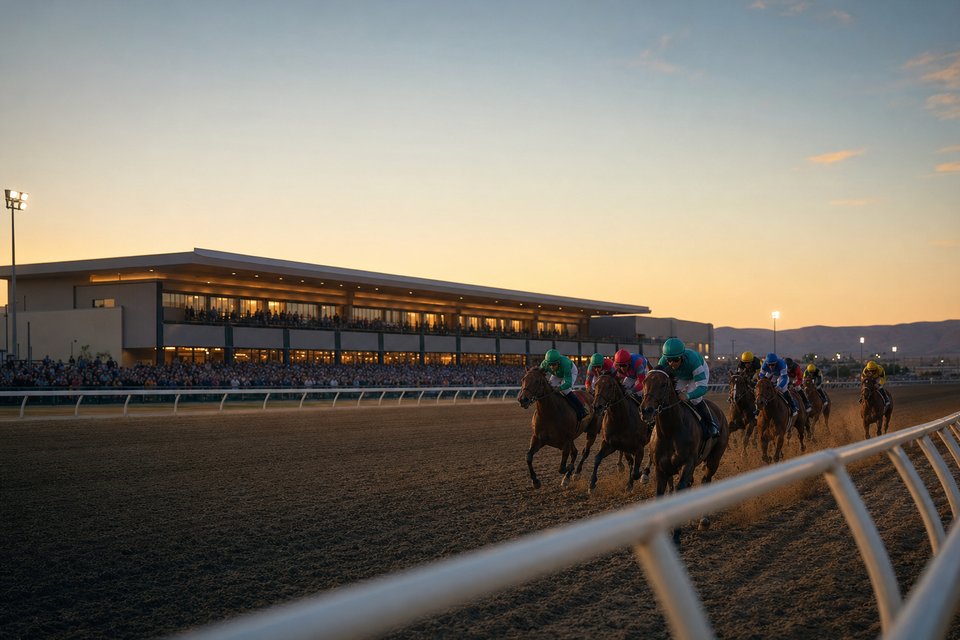
What Is a Racino? A Working Definition
A racino is a pari-mutuel racetrack that a state has licensed to run gaming machines or a casino on the same property. The track comes first in law: the gaming license exists because of the racing license, and most statutes require a minimum number of live race days each year for the machines to stay switched on.
The answer to what is a racino therefore depends partly on the state. In Ohio it means a harness or thoroughbred track with lottery terminals. In Pennsylvania it means a full commercial casino whose owner also runs a track, such as Parx in Bensalem. In Minnesota the gaming is a card room with no slots at all.
Racino meaning and where the word came from
The racino meaning is a portmanteau of race track and casino. The word entered American usage around 1995, when Prairie Meadows outside Des Moines opened roughly 1,100 slot machines on April 1 of that year. Its first twelve months of machine play produced $119.3 million, and Polk County, which owned the track, retired its bonds early.
People search the term in many forms, from whats a racino to what are racinos, and the answer stays the same: a track first, a gaming hall second. The two halves share parking, restaurants and often a grandstand, and the racing calendar tends to set the rhythm of the busiest weekends at the property.
What Is a Racino Compared With a Racetrack?
Every racino is a racetrack, but most American racetracks are not racinos. Churchill Downs, Keeneland, Santa Anita, Belmont Park and Del Mar run some of the best-known meets in the country without a slot machine on the grounds. Their revenue comes from betting handle, media rights, admissions and, in Kentucky, historical horse racing elsewhere.
So what is a racino adding to a plain track? A second business open every day. A harness oval may race on forty or fifty nights, while the gaming floor beside it stays open around the clock. That steady traffic pays for staff, upkeep of the barns and track surface, and the purses that attract horses.
How Gaming Works at a Racino
Gaming at racinos comes in five broad forms, and a single state usually allows only one or two of them. The form decides who owns the machines, how outcomes are produced and whether visitors will find a blackjack dealer or only screens. The list below covers the formats found at American tracks in 2026.
- Video lottery terminals (VLTs): lottery-owned or lottery-controlled machines linked to a central system, used in Ohio, New York, Delaware and West Virginia.
- Class III slot machines: standard casino slots with their own random number generator, as in Pennsylvania, Indiana and Iowa.
- Table games: live dealers at blackjack, roulette and craps where the state allows them.
- Card rooms: poker and house-banked card games, the model at Minnesota tracks.
- Historical horse racing (HHR) machines: slot-style terminals that settle bets on replayed past races, the model in Kentucky and Virginia.
Video lottery terminals and central determination
New York’s racetrack machines show how the lottery version works. Every terminal is linked to a central system run for the state Gaming Commission, which records each play and issues predetermined outcomes to the machine, much like drawing a ticket from a finite pool. The simulator on this page walks through that process one wager at a time.
Ohio, Delaware and West Virginia also call their racetrack machines video lottery terminals, and the state lottery remains the legal operator even when the track owns the building. The full explanation, including payback rates and the revenue split, sits on the video lottery terminals guide, which also compares the devices with the slots found at commercial casinos.
So what is a racino in terms of the floor a visitor walks onto? In a lottery state, rows of screens that look like slots but report every play to the state. In a casino state, the same machines plus dealers. In a historical racing state, reels that settle bets on old races, with a replay window in the corner.
Historical horse racing machines
Kentucky and Virginia never legalized slots at tracks, so their tracks use historical horse racing machines. Each spin is a pari-mutuel wager on a race that has already been run, with names and dates hidden. Results appear as spinning reels, and the race replay plays in a small window on the screen.
Where the Money Goes: Purses, Breeding and Taxes
The core of the model is a statutory share of machine revenue paid to racing. Delaware’s lottery reports for fiscal 2025 show about 11 percent of video lottery net proceeds going to purses, roughly 38 percent to the state and the rest to vendors and the three tracks. That purse money pays for Delaware Park’s summer meet.
Pennsylvania routes its share through the Race Horse Development Fund. In the state’s July 2026 slot report, Mohegan Pennsylvania paid about $1.39 million into the fund on $15.78 million of gross terminal revenue, close to 9 percent. Ohio rules set the racing share at 9 to 11 percent of video lottery income, depending on how much each track invested.
The racino revenue guide tracks these figures month by month. The pattern repeats across states: purses rise sharply in the first years after machines arrive, field sizes grow, and breeders in that state gain a reason to keep foaling. When machine revenue falls, as it did during the 2020 closures, purses fall with it.
Racino vs Casino vs Tribal Casino vs OTB
Visitors often meet four kinds of gaming venue within a short drive, and the differences are legal more than visual. The racino vs casino question in particular confuses people because many racinos have the same machines, buffets and hotel towers. The table sets out how each type is licensed and what it is allowed to offer.
| Venue type | License basis | Live racing | Typical gaming |
|---|---|---|---|
| Racino | Racetrack license plus gaming rights | Yes | Slots or VLTs, sometimes tables |
| Commercial casino | Stand-alone state casino license | No | Slots, tables, often a sportsbook |
| Tribal casino | Tribal-state compact under federal law | No | Class II and Class III games |
| Off-track betting (OTB) | Pari-mutuel simulcast license | No | Race wagering only |
Racino vs casino in practice
The racino vs casino split shows in the rules more than the décor. Ohio’s seven racinos may offer only lottery terminals, while its four commercial casinos run live blackjack and craps. In Pennsylvania the line has almost vanished, because racetrack licensees hold Category 1 licenses that carry the same slots, table games and online rights as the stand-alone casinos.
Tribal casinos sit on a different legal footing again. They operate under the federal Indian Gaming Regulatory Act and a compact with the state, and they pay no share to horsemen. Oklahoma shows both systems side by side, with tribal casinos across the state and racetrack gaming at Remington Park and Will Rogers Downs.
An off-track betting parlour is the simplest of the four. It takes wagers on races broadcast from other tracks, and most have no machines. In Kentucky and Virginia some satellite venues blur the boundary by adding historical horse racing terminals, so a building with no track can hold more than a thousand machines.
Which States Have Racinos
Racinos operate in about 20 states in 2026. The largest groups are in Ohio, New York, Pennsylvania, Louisiana, New Mexico and Nebraska, the newest racino state. Each state page lists every venue with its racing season and gaming type, and the map on the racinos near me page sorts them by distance from any address.
- Ohio: seven VLT racinos, from Northfield Park to Belterra Park.
- New York: lottery-terminal tracks such as Saratoga and Batavia Downs.
- Pennsylvania: six racetrack casinos with tables and online licenses.
- West Virginia: four tracks, two still racing greyhounds.
- Nebraska: casinos at licensed tracks since a 2020 vote, see the Nebraska page.
- Kentucky and Virginia: historical horse racing at tracks and satellites, see Kentucky.
Smaller groups exist in Delaware, Louisiana, Iowa, Indiana, Oklahoma, Florida, Maryland, Maine, Massachusetts, Minnesota, Arkansas and Illinois. Other states have lost theirs. Rhode Island’s two pari-mutuel venues lost their racing, Hawthorne near Chicago sold its land in 2026 without ever opening its licensed casino, and Aqueduct in New York ended live racing on June 28, 2026.
The Meaning of Racino in Each State’s Law
Statutes rarely use the word. Ohio law speaks of video lottery sales agents, New York of video lottery gaming at racetracks, Pennsylvania of Category 1 facilities, and Maryland of video lottery operation licenses. The racino meaning in everyday speech is broader than any of these legal labels, which is why lists of racinos vary from source to source.
The legal wording matters to visitors because it decides what is on the floor. A Category 1 license in Pennsylvania brings live poker and blackjack. A video lottery agent in Ohio may offer only screens. Maryland’s lone track with gaming, Ocean Downs near Berlin, runs slots and table games under the same casino law as the state’s large urban casinos.
The Case For and Against Racinos
Supporters point to what the machines kept alive. Delaware’s thoroughbred and harness meets, West Virginia’s Charles Town and Ohio’s harness circuit all draw purses from gaming, and breeding farms in those states depend on the restricted races those purses fund. Without the machine share, several tracks would likely have closed during the long decline in racing handle.
Critics call the arrangement a subsidy and ask why slot players should pay for horse racing. The question returns whenever a state budget is tight. Florida decoupled slots from racing for some pari-mutuels in 2021, which let Pompano Park end harness racing in 2022 while its casino stayed open as Harrah’s Pompano Beach.
Purse dependence carries its own risk. When machine revenue drops, through a recession, a new casino nearby or a pandemic closure, purses shrink at once. Animal welfare groups add a separate objection, pointing to breakdowns at some tracks, and the greyhound bans in Florida and elsewhere began as exactly that kind of argument against gaming-funded racing.
Visiting a Racino: What to Expect
A first visit usually starts on the casino floor, because that part stays open all year. Live racing runs on set days in season, and the horse racing schedule lists post times for each track. Simulcast rooms show races from other tracks daily, and the betting basics are explained on the pari-mutuel betting guide.
Food and lodging vary widely. Some racinos are small regional halls with a grill and a buffet; others, such as Charles Town in West Virginia or Delta Downs in Louisiana, run hotels, steakhouses and concert venues. Each venue page lists the restaurants, hotel and parking details, along with directions from the nearest city.
Adults should expect to show photo identification at the casino entrance. Most racino floors admit players from 21, while betting windows sometimes accept wagers from 18, depending on state law. Setting a spending limit before arriving keeps the evening affordable, and every state with racinos runs a free helpline listed on this site’s responsible gambling page.