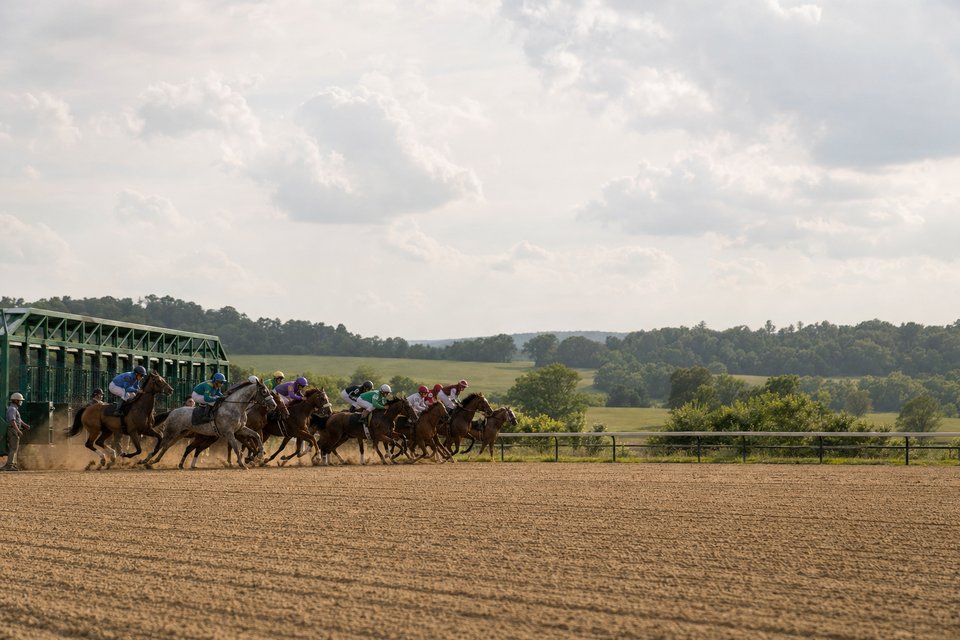
How Virginia historical horse racing works
A historical racing terminal looks like a slot machine, but the bet is pari-mutuel. Each wager joins a pool shared with other players, the system draws a race that has already been run somewhere in North America, hides the track, date and horse names, and pays according to that result. The spinning reels are only a display.
Legally, that makes Virginia historical horse racing a form of pari-mutuel betting on horses, regulated by the racing commission rather than by the state’s casino law. There are no house-banked table games at any of these venues. The historical horse racing guide traces the game’s origins in Arkansas and compares the rules in each state that allows it.
The 2018 law and the Virginia Racing Commission
Chapter 811 of the 2018 session, signed in April that year, added historical racing to section 59.1-392 of the Code of Virginia. It allowed the machines at the licensed racetrack and at satellite wagering facilities, which the Code originally limited to ten, and each satellite needs a local referendum approving pari-mutuel wagering before the commission may license it.
The Virginia Racing Commission, based at Colonial Downs, licenses the track and every satellite, approves race dates and reports wagering monthly. Its rules tie gaming to racing directly: for every 100 terminals added beyond the original allotment, the track must hold one more live race day, which is why the calendar has grown alongside the machines.
Terminal limits by locality
The law permits 5,000 historical racing terminals statewide. A locality with 120,000 or more residents may host up to 700, one with 60,000 to 120,000 up to 300, and smaller places up to 150. Those limits shape where Churchill Downs can grow. By December 2025, about 4,867 machines were deployed across the network, close to that ceiling.
Every Virginia historical horse racing venue
All eight venues belong to Churchill Downs Incorporated, which bought Colonial Downs and the Rosie’s business in 2022. The track itself is the only site with live racing; the others are licensed satellites that also take simulcast bets. Counts come from operator pages, a December 2025 commission meeting and opening reports.
| Venue | City | Racing | Gaming |
|---|---|---|---|
| Colonial Downs (Rosie’s New Kent) | New Kent | Live thoroughbred racing | About 600 machines |
| Rosie’s Richmond | Richmond | Simulcast | 1,199 machines |
| The Rose Gaming Resort | Dumfries | Simulcast | 1,650 machines, hotel |
| Rosie’s Hampton | Hampton | Simulcast | 38,380 sq ft gaming floor |
| Rosie’s Vinton | Vinton | Simulcast | About 500 machines |
| Rosie’s Emporia | Emporia | Simulcast | 150 machines |
| Roseshire Gaming Parlor | Henrico | Simulcast | 175 machines at opening |
| Rosie’s Game Room | Collinsville | Simulcast | 37 machines |
The track and the parlors, location by location
Colonial Downs in New Kent County reopened in 2019 after five dark years, and the first Rosie’s opened on its ground floor on April 23, 2019. Vinton followed in May, Richmond in July and Hampton in October of that year. Each early satellite went to a locality that had already voted for off-track betting under the older 1992 rules.
Northern Virginia came in stages. A Dumfries parlor opened in January 2021, and The Rose Gaming Resort, a $460 million building on the former Potomac Landfill, soft-launched on October 23, 2024, with 1,650 machines and a hotel. The Collinsville Game Room opened in July 2021, and Emporia, the first Rosie’s built from the ground up, opened in September 2023.
The newest site, the Roseshire Gaming Parlor at the Staples Mill Shopping Center in Henrico, opened on September 29, 2025, after county officials argued for a fresh local vote and the operator relied on an earlier referendum. Addresses, hours, dining and the hotel at The Rose are covered on the grouped Rosie’s Gaming Emporium page.
Wagers, machines and revenue
The growth of Virginia historical horse racing shows clearly in the wagering totals. Fiscal 2019, with only a few weeks of play, saw $174.3 million wagered. That rose to $1.41 billion in 2020, $2.42 billion in 2021, $3.88 billion in 2022 and $4.21 billion in 2023, reaching $4.5 billion in fiscal 2024 as the machines spread across the state.
Most of that money returns to players. In fiscal 2024 the machines paid out about $4.09 billion, leaving net revenue of $408.9 million, 7.5 percent more than a year earlier. Tax revenue grew faster, by 11.3 percent: the state took $28.8 million, host localities $22.5 million, and the Breeders Fund and three other horse bodies about $1.1 million each.
Who gets each wager
The licensee retains 1.30 percent of every pool for fees. At the racetrack, 0.56 percent goes to New Kent County. The problem gambling fund receives 0.01 percent, and the Breeders Fund, the regional veterinary college, the Virginia Horse Center Foundation and the Horse Industry Board 0.025 percent each, with the rest paid as state license tax.
Satellites used to split their local share evenly with New Kent, which collected $12.8 million in fiscal 2024, most of it from parlors elsewhere. A 2026 amendment ended that arrangement: from July 1, 2026, the full 0.56 percent of satellite wagers goes to the locality where the parlor stands. More comparisons across states are on the racino revenue page.
Virginia historical horse racing also competes with the state’s commercial casinos, licensed separately in cities such as Bristol, Portsmouth and Danville. The closest comparison is Kentucky, where the same type of machine runs at tracks and satellite halls, while West Virginia runs full racetrack casinos with slot machines and table games, and Maryland has slots at Ocean Downs.
Virginia racing calendar for the rest of 2026 and beyond
Colonial Downs received a record 48 race days for 2026, opening with a three-day meet in March around the $500,000 Virginia Derby, the state’s only Kentucky Derby qualifier, then a summer meet from June 25 to September 7. The 2025 summer season had already set records, with 44 days and more than $100 million wagered.
Harness horses race at Shenandoah Downs in Woodstock, where the spring meet ran from April 11 to May 24, 2026, and the fall meet ran on Saturdays and Sundays from September 19 to November 1, with a 1:05 p.m. post. Steeplechasing centers on the Virginia Gold Cup in May and its fall edition on October 24.
- March: Virginia Derby meet at Colonial Downs.
- April and May: Shenandoah Downs spring harness meet; Virginia Gold Cup steeplechase.
- Late June to Labor Day: Colonial Downs summer thoroughbred meet.
- September to November 1: Shenandoah Downs fall harness meet (the 2026 meet has ended).
Simulcast wagering continues all year at every Rosie’s, so bettors can follow tracks in other states once the Virginia meets end. Dates for those tracks appear on the national horse racing schedule, and the commission approved the 2026 Colonial Downs dates at its meeting on December 15, 2025, so the 2027 calendar is expected from the same body.